Technology and science have grown remarkably in recent years, to the point that today we have tools that would have been unthinkable before, many times right in the palm of our hand through a simple app on our phones.
This can feel intimidating and overwhelming if we become obsessed with using the huge number of products and services that promise to measure, calculate, and even solve all our physical problems or improve our golf handicap.
That said, there are very good options that help us build a better version of ourselves. But it is important to understand that all these apps are tools. They help — and many times they help a lot — but they can also overwhelm us with an abundance of information that does not always contribute to the goal we are trying to achieve. Also, on their own, they are not enough to understand what the right strategy should be.
This matters because, even when we have the data, we still face the challenge of analyzing it and turning it into an actionable plan.
In training, especially when we talk about golf, many decisions are made based on sensations: “I feel stiff,” “I lost distance,” “I have trouble rotating,” “I finish with low back pain,” “I don’t know if I’m improving.” All those sensations matter, but they are not always enough to design a precise program.
That is why I use technology as part of a working strategy: to assess better, plan with more criteria, measure responses, adjust loads, and clearly show the client what they are doing, why they are doing it, and how they are progressing.
It is not about filling the training process with devices. It is about choosing tools that help make better decisions.
Technology is not complexity: it is clarity
A good training program should not depend on improvisation.
Before deciding which exercises to do, how many sets to use, what mobility to prioritize, or what type of strength to train, I need to understand a few things:
- How the person moves.
- What ranges of mobility they have available.
- What compensations appear during movement.
- What level of strength and power they can express.
- How they respond to training.
- What load they can tolerate without accumulating unnecessary fatigue.
- What their real goal is: playing without pain, gaining distance, improving stability, preparing for a season, or simply training better.
Technology helps turn that information into observable data. Not to make the process colder, but to make it clearer.
A simple example: if a golfer feels they are lacking rotation in the backswing, the problem may be — and often is — in the thoracic spine, the hip, core control, shoulder mobility, setup, or a combination of factors. Without assessment, everything is a hypothesis. With analysis tools, that hypothesis can be organized.
1. Movement assessment: seeing what the eye can miss
One of the most important uses of technology is movement analysis.
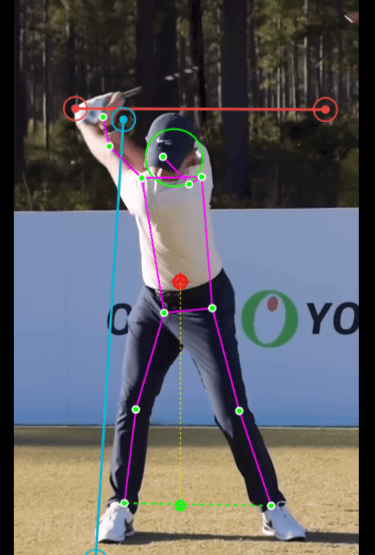
Through video, AI-based joint point detection, angle measurement, right-side/left-side comparison, and frame-by-frame analysis, it is possible to observe details that often cannot be perceived in real time.
This can be applied to general movements such as:
- Squat.
- Deadlift.
- Thoracic rotation.
- Lunges.
- Shoulder movements.
- Lumbopelvic control.
- Stability patterns.
And also to more golf-specific gestures, such as pelvic rotation, thoracic mobility, the ability to dissociate upper and lower body, or stability in positions similar to the stance.
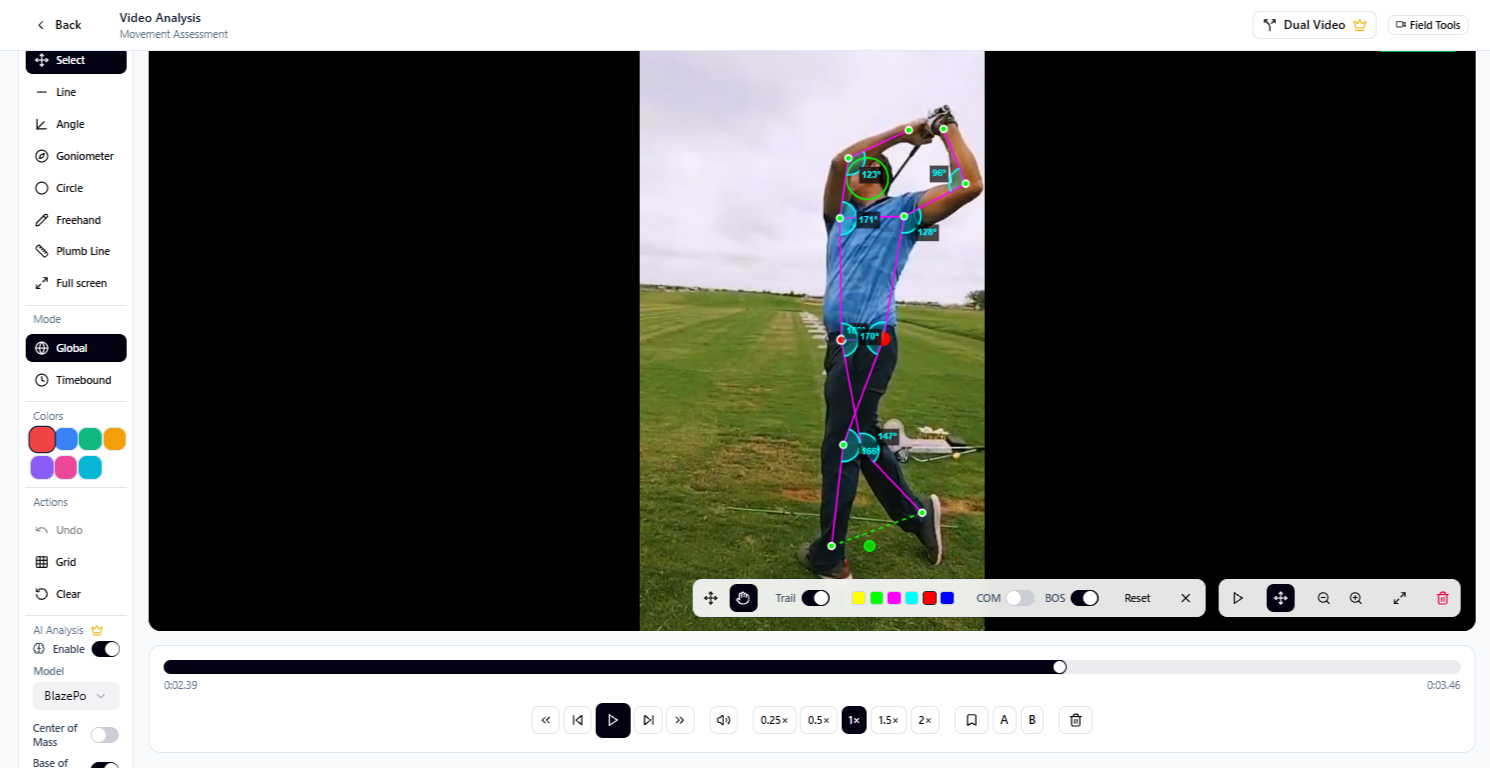
The important thing is not measuring for the sake of measuring. The important thing is that this information allows practical decisions to be made.
For example:
- If there is limited thoracic rotation, the plan may include specific mobility and rotational control.
- If the hip does not rotate well, there may be mobility work, strength through large ranges of motion, and pelvic stability.
- If knee valgus appears in loading patterns, hip control and unilateral strength may be prioritized.
- If there is poor trunk control, it may make sense to work on anti-rotation, stability, and progressive core patterns.
The assessment is not the end of the process. It is the starting point. In my case, I use my own analysis platform available at bodytoolkit.fit.
2. Measuring power, strength, and speed: knowing which capacity we are training
When we talk about distance, we are indirectly talking about power.
Swing speed does not depend only on “hitting harder.” It depends on your mobility, strength, coordination, swing sequence, ability to apply force quickly, and efficiency in transferring that energy to the sport-specific gesture.
That is why, when the goal is to improve performance, specific tools can be used to measure different capacities.
Swing speed radar
Performance radars allow us to measure variables such as swing speed, ball speed, or different parameters related to the shot, always depending on the capabilities of the device being used.
For my swing speed assessments, I use a reliable pocket radar such as PRGR in indoor spaces; and in open spaces where golf shots can be performed, I use the Garmin R10 radar.


Devices such as Garmin or PRGR are useful to observe whether physical work transfers to the sport-specific gesture.
For example:
- Did speed improve after mobility and strength work?
- Are there speed differences before and after a power session?
- Does speed improve, but pain or stiffness appear?
- Does technique tolerate the increase in intensity?
- Are concrete improvements observed over time?
The Stack System

The Stack System is an example of a tool oriented toward swing speed training. It is useful within a broader strategy, as long as it is not used as an isolated solution.
If there is one key point when developing swing speed, it is having a functional structure capable of tolerating the different force vectors created when hitting the ball at your maximum capacity.
Think of the body as a car. Imagine a mid-range car that receives high-performance upgrades so it can accelerate better and reach a higher top speed. If the person making those upgrades only focuses on boosting certain parts of the car to achieve the goal quickly, the consequence of that strategy will be that the vehicle starts to show weak points that are not prepared to tolerate those new loads and, as a result, eventually break down.
Developing more clubhead speed is absolutely possible at any age, but there is one important condition: to achieve it without damaging the body, we need to build the foundations that allow for higher performance without putting the machinery at risk.
Jump platform
A jump platform allows us to assess variables related to lower-body power, the ability to produce force quickly, and neuromuscular evolution.
This can be especially useful because golf, even though it may not seem like a jumping sport, depends heavily on the ability to apply force against the ground very quickly. Amateur players generally do not have enough speed to generate and transfer kinetic energy fast enough to take advantage of it at impact.
With a jump platform, we can observe things such as:
- Jump height.
- Estimated power.
- Differences between one leg and the other.
- Improvements between assessments.
- Response to strength or power blocks.
I do not use this type of assessment to turn a golfer into a jumper. I use it to understand whether their system is gaining the ability to produce force and express it quickly. Today, this type of jump assessment is the gold standard for measuring lower-body power.
Handgrip
Handgrip or grip dynamometry is a simple, fast, and useful measurement.
In golf, grip strength should not be interpreted as “squeezing the club harder.” Excessive tension in the hands can be counterproductive. But measuring grip strength can provide general information about strength, asymmetries, and changes over time.
The handgrip test is a highly reliable biomarker for measuring general physical condition, neuromuscular health, and biological aging. It is used in clinical settings to predict long-term mortality risk, the probability of chronic diseases, and the appearance of physical disabilities. In my case, I use it as another parameter to assess the general physical condition of my clients.
It can also be useful to:
- Compare right and left side.
- Detect loss of capacity after pain, injury, or fatigue.
3. Digital planning
Technology also serves a practical function: helping clients have their training plan clear, organized, and accessible.
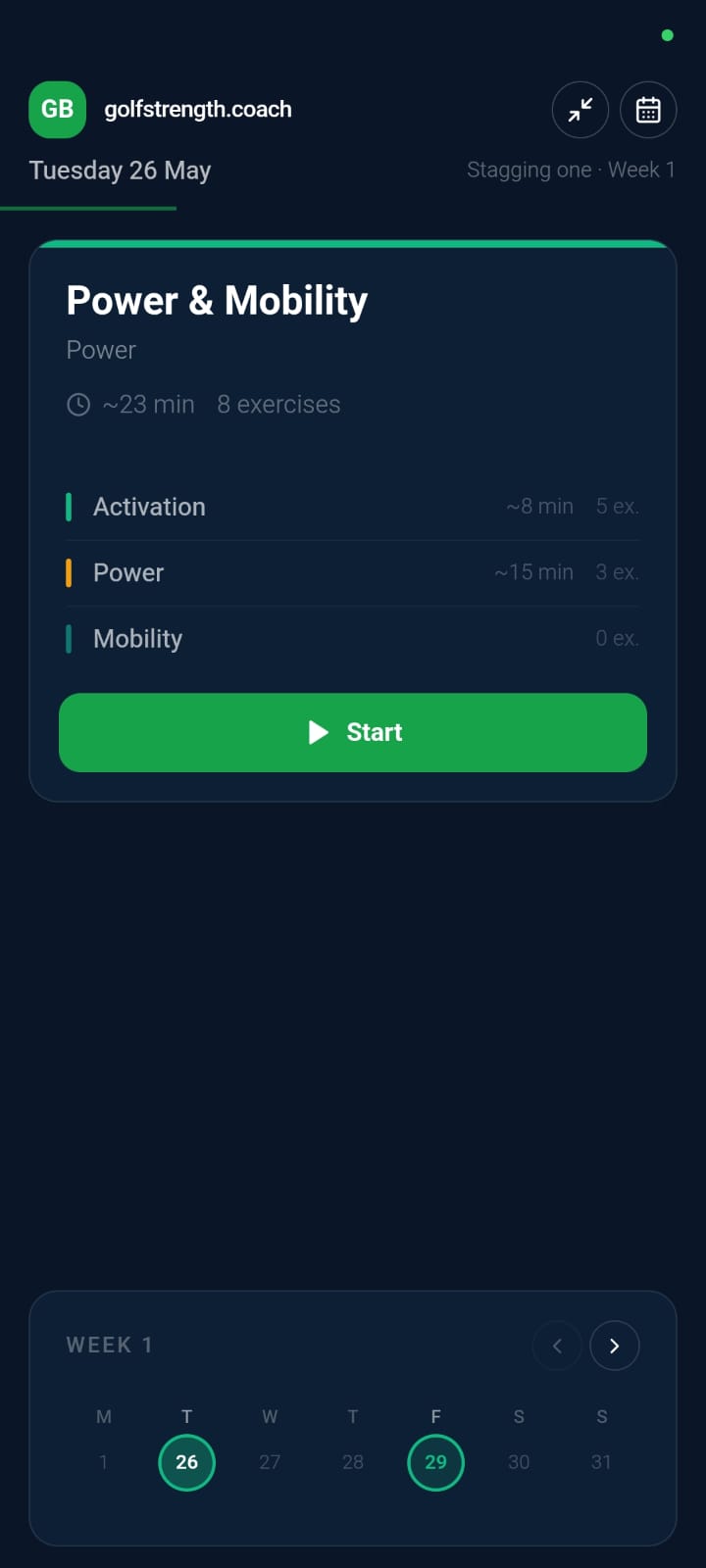
For that, I use my training session management app, where the client can see their sessions, work blocks, exercises, videos, dosage, rest times, and more.
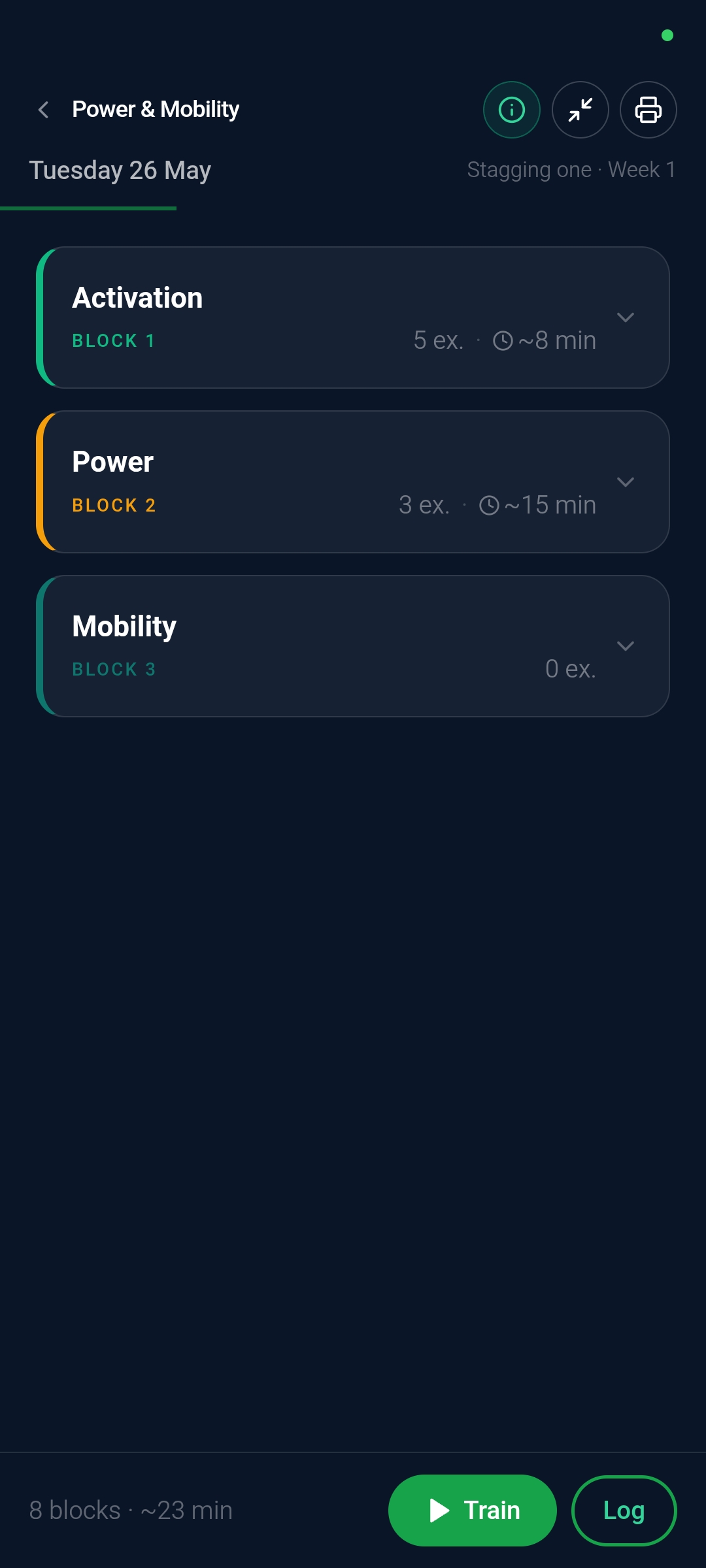
This avoids one of the most common problems in remote training: confusion.
The client does not have to guess which exercise to do, how many repetitions to perform, how long to rest, or in what order to complete the block. The plan is presented in a simple and clear way.
A session can be organized into blocks, for example:
- Activation.
- Power.
- Strength.
- Mobility.
- Core.
- Recovery.
4. Videos and execution: reducing errors in remote training
In online training, exercise explanation is fundamental.
Seeing the name of an exercise is not enough. It is important to know how to perform it, what should be felt, what mistakes to avoid, or how to adjust the range if something causes discomfort.
That is why the app allows demonstration videos to be displayed within each exercise, together with the corresponding dosage.
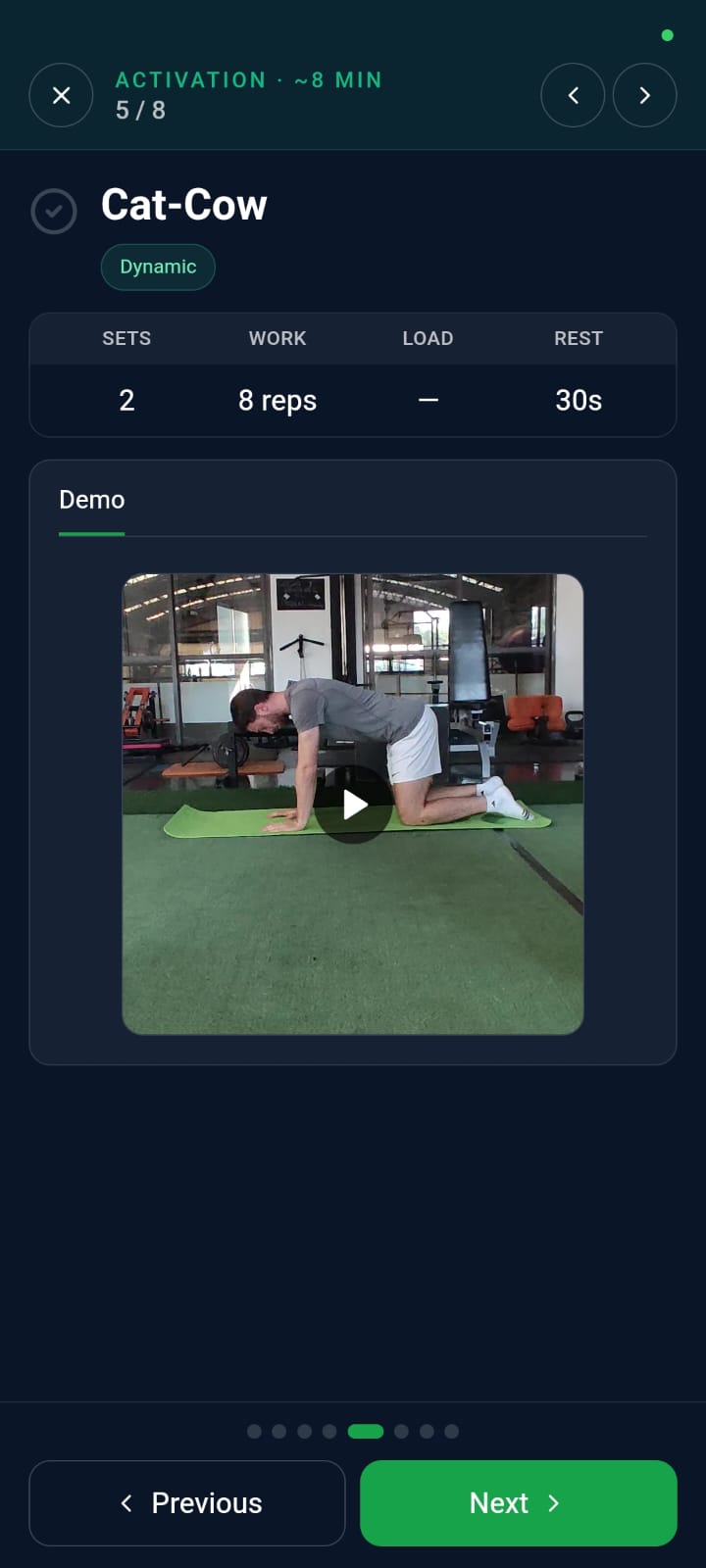
This helps the client have a clear visual reference.
For example, if the exercise is a cat-cow, thoracic rotation, hip hinge, or Pallof press, the video reduces ambiguity. The client can see the starting position, rhythm, direction of movement, and objective.
Even so, video does not replace feedback. It is a tool to improve execution, not an automatic guarantee of perfect technique.
5. Tracking response: training better, not just training more
One of the most important points in any program is understanding how the person responds.
Not everyone tolerates the same load. Not everyone recovers the same way. Not everyone arrives with the same stress, sleep quality, injury history, or real availability.
That is why, after each session, the client can record simple variables such as:
- RPE or perceived exertion.
- General feeling of the training session.
- Subjective notes.
- Discomfort or adjustments needed.
- Perceived quality of the session.
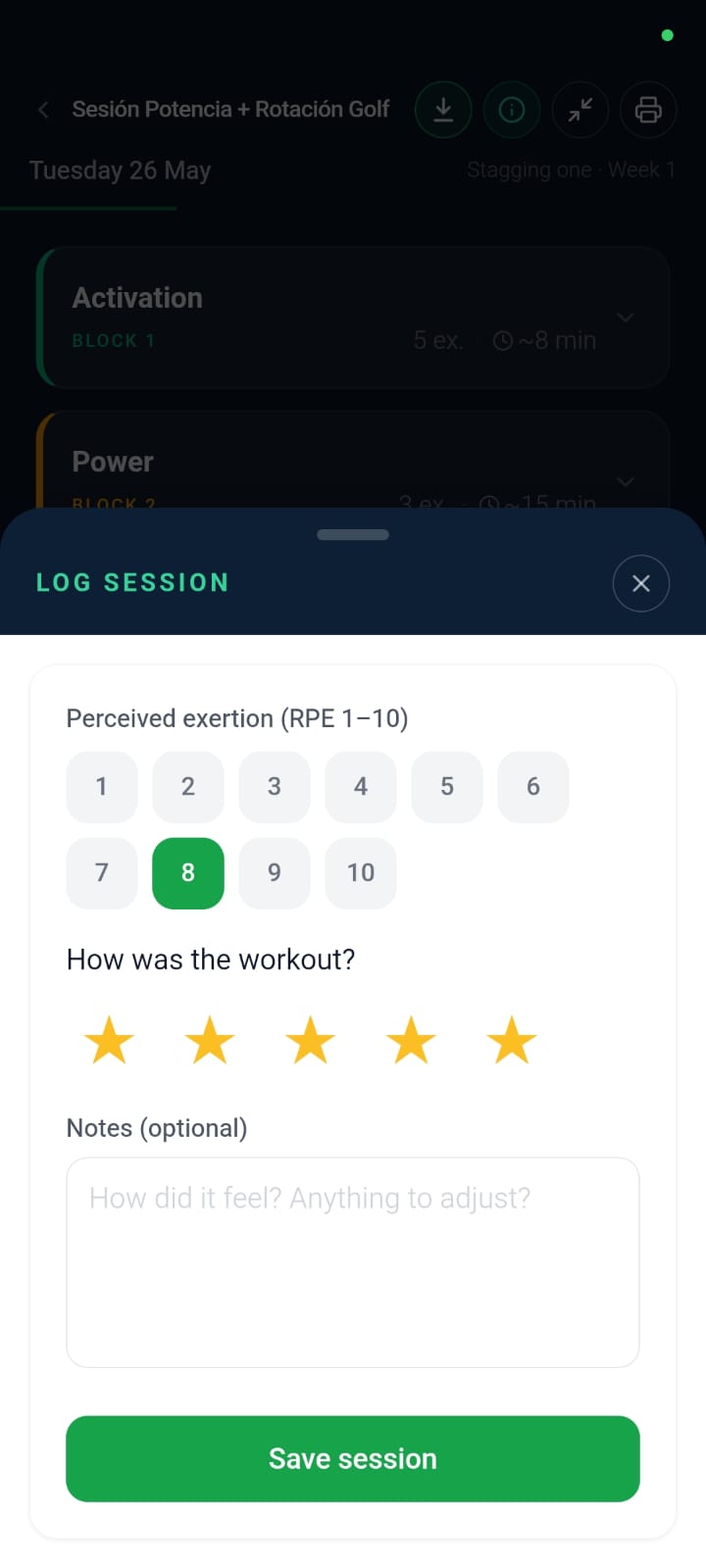
This is key because it allows the plan to be adjusted using real information.
For example:
- If a session planned as moderate is perceived as 9/10, something needs to be reviewed.
- If pain appears after certain exercises, selection, range, or load must be adjusted.
- If the client completes everything easily for several weeks, it may be time to progress.
- If fatigue rises and performance drops, it may be better to deload before pushing further.
6. Data + judgment: the combination that really matters
The mistake would be thinking that more technology automatically means better training, but as I proposed at the beginning, that is not quite the case.
A radar, a jump platform, an app, an AI analysis, or a handgrip measurement are not very useful if there is no judgment behind them.
The value lies in connecting the data with a practical decision.
For example:
- If the radar shows a drop in speed, there may be fatigue, lack of power, a poor warm-up, or a technical issue.
- If the movement analysis shows limited thoracic rotation, it is important to assign part of the training process to improve that point.
- If the jump platform shows low power, it gives us a good starting point to know where to focus.
- If the RPE reported by the user differs from what was planned, it allows quick adjustment of session parameters such as volume, intensity, or rest times, to name a few.
7. Movement pattern assessment
Based on the initial assessment, priorities can be defined, such as:
- Restoring useful mobility.
- Improving general strength.
- Building stability.
- Increasing power.
- Improving load tolerance.
- Reducing compensations.
- Preparing the body to tolerate more speed.
- Maintaining golf practice without pain or excessive fatigue.
Technology as part of a broader strategy
I use technology because it allows me to better organize the entire training process: tracking the parameters of each session, maintaining a clear history, evaluating progression, recording achievements, digitizing routines, and making sure each person has their plan available no matter where they are.
But the main value is not simply having a routine inside an app or accumulating data. The real value is that these tools allow us to build a clearer, more measurable, and more sustainable work system over time.
When a person can see what they need to do, understand why they are doing it, record how they felt, and observe their evolution, training stops being a succession of isolated exercises and starts becoming a process. This helps build greater commitment, more autonomy, and a more concrete relationship between the effort made and the results obtained.
It also means that feedback does not depend only on general sensations such as “I feel better” or “this feels harder.” Those sensations are important, but when they are combined with logs, videos, measurements, and load tracking, they become more useful information to adjust the plan.
My final goal is not for the person to depend on an app, a device, or a measurement. My goal is for them to train with more certainty, effectiveness, safety, and autonomy, understanding what they are doing today and how that connects with their medium- and long-term goals.